
Rigging · Toolbox topic
Wire rope clips: never saddle a dead horse
Week of
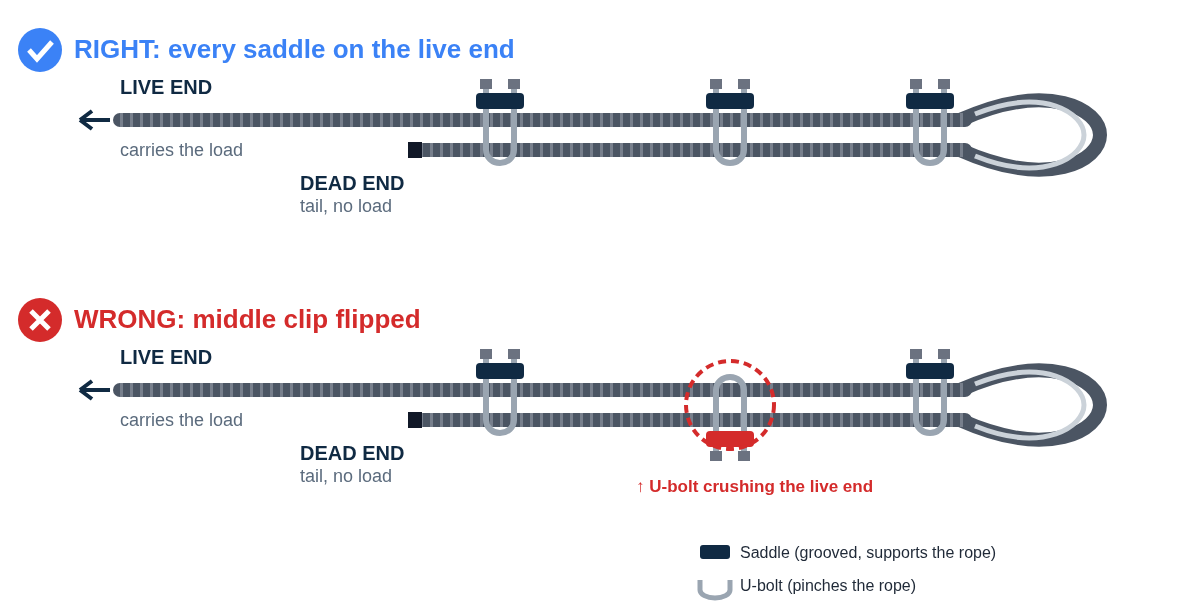
Many of us were taught to flip the middle clip. That's wrong. Every saddle goes on the live end, every U-bolt on the dead end.
Read the Safety Minute transcript
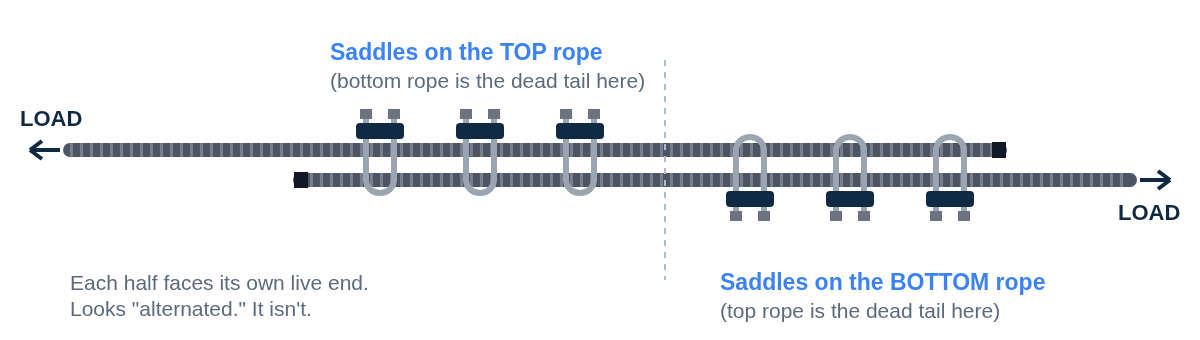
Good morning, Gaftek. This is your safety minute for the week of November second. This week's topic is wire rope clips, and I'll be honest, this one caught a lot of us off guard. For years, plenty of us were taught to flip the middle clip so the saddles alternate. That's wrong. OSHA, the clip manufacturers, and the tank manufacturers all say the same thing: Every saddle goes on the live end of the rope, the side that takes the load. Every U-bolt goes on the dead end, the short tail. Old riggers have a saying for it: Never saddle a dead horse. Here's why. The saddle is the forged part with the groove in it. It cradles the rope. The U-bolt does the opposite. It pinches and crushes the strands. You want that crushing on the tail, which carries nothing. Flip a clip, and you've crushed the part that's holding the load. Done right, a clipped eye keeps about eighty to ninety percent of the rope's strength. Done wrong, you can lose a big chunk of that. Five steps. One: turn back the amount of rope the clip maker calls for. Two: the first clip goes one saddle width from the end of the tail, U-bolt on the tail. Torque it. Three: the second clip goes as close to the thimble as you can get it. Four: space the rest evenly, take up the slack, and torque them all evenly. Five: put a load on it, then torque it again, and keep checking it. Now, for our tank crews. When you anchor a tank to dead men with wire rope, every loop follows the same rule. But on a wet hole job, where you splice two ropes together on top of the tank, the manufacturer's drawing shows half the clips facing one way and half facing the other. That's because each rope's live end comes from the opposite side. That drawing may be where the flip the middle clip habit came from, but it isn't alternating. Every saddle is still on a live end, and a splice needs twice the clips. Xerxes calls for at least four on three-eighths rope and six on half inch. So this week, look at every clip on your truck and on your jobs. If a saddle is sitting on a dead end, fix it before it takes a load. Work safe. See you next week.
Many of us were taught to flip the middle wire rope clip. That’s wrong. OSHA, the clip makers and the tank makers all agree: every saddle goes on the live end, every U-bolt on the dead end. Every clip. No exceptions.
- 80–90% of rope strength kept by a correctly clipped eye (Crosby)
- 40%+ strength loss possible with a wrong install (CraneTech)
- OSHA 1926.251(c)(5): U-bolt on the dead end
Why it matters
The saddle is the forged, grooved part. It cradles the rope. The U-bolt pinches and crushes the strands it bears on. Put the crushing on the tail, which carries no load. Flip a clip and you crush the part that’s holding the load.
Five steps to clip an eye right
- Turn back the right amount. Turn back the length of rope the clip maker specifies from the thimble.
- First clip: one saddle-width from the tail. U-bolt over the dead end, live end in the saddle. Torque the nuts evenly, alternating nut to nut.
- Second clip: tight to the thimble. As close to the loop or thimble as you can. Snug the nuts, but don’t fully tighten yet.
- Space the rest evenly. Take up the slack, then torque every clip evenly to the manufacturer’s spec.
- Load it, then re-torque. Apply a load and torque again. Keep checking during use. Rope stretches and clips loosen.
How many clips? (OSHA Table H-2, drop-forged)
| Rope diameter | Minimum clips | Minimum spacing |
|---|---|---|
| 1/2” | 3 | 3” |
| 5/8” | 3 | 3-3/4” |
| 3/4” | 4 | 4-1/2” |
| 7/8” | 4 | 5-1/4” |
| 1” | 5 | 6” |
Clips that aren’t drop-forged need one more clip at these sizes. Larger sizes are in 29 CFR 1926.251 Table H-2. Always follow the clip maker’s turnback and torque chart.
Tank crews: deadmen and hold-downs
Loops around a deadman or through a strap eye follow the same rule: all saddles on the live end. Xerxes calls for at least 2 clips on 3/8” rope and 3 on 1/2” per termination.
Wet-hole splice on top of the tank: when two ropes are joined, each rope’s live end comes from the opposite side. So in the manufacturer’s drawing, half the clips face one way and half face the other. It looks alternated. It isn’t. Every saddle still sits on a live end. A splice needs twice the clips: at least 4 on 3/8” and 6 on 1/2” rope (Xerxes Installation Manual, Section 8.3.17).
Before it takes a load
- Every saddle on the live end. No flipped clips.
- Right number of clips for the rope size.
- Spacing at least the table minimum.
- Torqued, loaded and re-torqued.
- Rope not kinked, crushed or birdcaged at the clips.
Found a flipped clip? Take the load off, redo the termination, and inspect the rope where the U-bolt sat.
Foremen: talk it over with your crew
- Where do we use wire rope clips on our jobs and trucks?
- Grab a clipped eye. Is every saddle on the live end?
- Who has a torque wrench and the clip maker’s torque chart?
- Tank crews: how do we splice hold-down ropes on wet-hole jobs?
Work safe.
- OSHA 29 CFR 1926.251(c)(5) and Table H-2
- Crosby forged wire rope clip application instructions
- Xerxes FRP UST Installation Manual, Section 8.3
- CraneTech, "Wire Rope Clips 101"